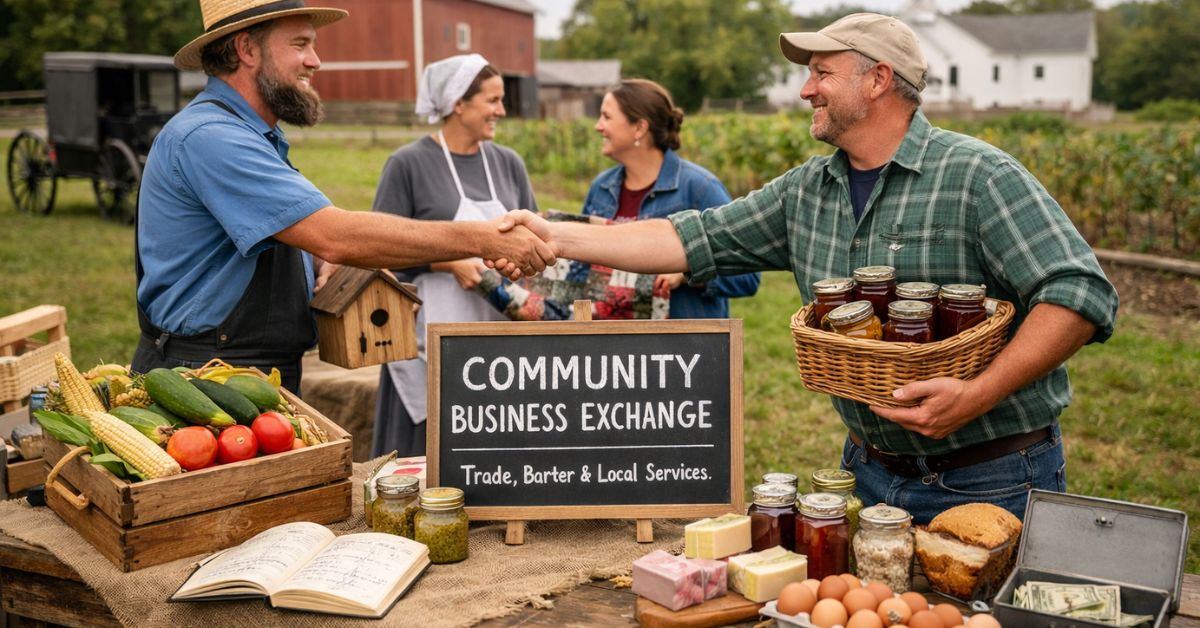
A plain community business exchange is not a trend driven by apps or hype. It is a grounded system where local businesses, freelancers, and individuals trade goods and services within a trusted network. Sometimes money is used, sometimes it is not. The focus is on mutual benefit, transparency, and long term relationships.
What Is a Plain Community Business Exchange?
A plain community business exchange is a local or regional system where members exchange goods or services directly, often without relying on national platforms or complex financial tools. It can involve barter, service credits, or agreed pricing, but the rules are simple and community driven.
Core Definition and Structure
At its core, this type of exchange prioritizes:
- Local participation
- Clear rules
- Trust-based relationships
- Simple record keeping
Unlike digital marketplaces, there is usually no algorithm controlling visibility. Members know who they are trading with. Decisions are made by people, not systems.
How It Differs From Modern Marketplaces
Online platforms optimize for scale and profit. A plain community business exchange optimizes for stability and fairness. Growth is intentional, not aggressive.
Why the “Plain” Aspect Matters
The word plain matters because complexity often creates exclusion. When systems are easy to understand, more people can participate, including small business owners who do not want to manage multiple digital tools.
How a Plain Community Business Exchange Works in Practice
The mechanics of a plain community business exchange are straightforward, but structure still matters to avoid confusion and disputes.
Membership and Participation
Most exchanges require members to:
- Register locally
- Agree to basic terms
- Offer a product or service
Membership may be limited to ensure quality and trust.
Exchange Methods
Common methods include:
- Direct barter (service for service)
- Service credits tracked manually
- Local vouchers accepted by members
Basic Record Keeping
Some groups use spreadsheets, others use notebooks or simple tools. The goal is accountability without overengineering.
Decision Making
Rules are often adjusted through group meetings or votes. This keeps control within the community rather than external owners.
Key Features That Define a Plain Community Business Exchange
A plain community business exchange works because of its features, not despite its simplicity.
Transparency
Prices, expectations, and limitations are discussed openly. This reduces misunderstandings.
Flexibility
Members can negotiate value based on context rather than fixed pricing models.
Local Accountability
If someone fails to deliver, consequences are social, not automated. Reputation matters.
Low Barrier to Entry
No advanced technical knowledge is required. This is especially helpful for older business owners or non-digital services.
Human Oversight
Every exchange is overseen by people who understand local needs, not distant moderators.
Benefits of a Plain Community Business Exchange for Local Economies
The value of a plain community business exchange is most visible at the local level.
Economic Resilience
When national supply chains fail or prices fluctuate, local exchange systems help communities adapt.
Support for Small Businesses
Small businesses gain access to services they might not afford otherwise, such as marketing, repairs, or consulting.
Skill Utilization
People can trade underused skills, turning idle time into value.
Stronger Relationships
Repeated exchanges build trust, which often leads to paid referrals outside the exchange.
Reduced Cash Pressure
For new businesses, reducing immediate cash expenses can be the difference between survival and closure.
Risks and Limitations You Should Understand
A plain community business exchange is not risk free, and ignoring limitations leads to failure.
Valuation Disputes
Not all services are easy to value. Clear guidelines help, but disagreements can still occur.
Uneven Participation
Some members may take more than they give. Strong moderation is required.
Tax and Legal Considerations
In the US, barter transactions may still be taxable. Members should understand basic compliance.
Scalability Issues
What works for 20 members may break at 200. Growth must be managed carefully.
Time Commitment
Building trust takes time. This is not a quick win system.
Plain Community Business Exchange vs Digital Business Networks
Below is a simple comparison to clarify differences:
| Feature | Plain Community Business Exchange | Digital Business Platforms |
|---|---|---|
| Control | Community driven | Platform owned |
| Costs | Low or none | Fees and commissions |
| Trust | Relationship based | Rating based |
| Complexity | Simple rules | Algorithm driven |
| Scale | Local | Global |
This comparison shows why many communities still prefer plain systems despite digital convenience.
Usability in 2025 and Beyon
In 2025, the plain community business exchange is evolving, not disappearing.
Hybrid Models
Some communities combine simple tools like shared documents with in person meetings.
Local Governance
Groups are creating basic charters to handle disputes and onboarding.
Integration With Local Media
Community blogs and platforms such as local business journals or resources like usmagazine are often used to share updates, success stories, and guidelines.
Adaptation to Regulations
More exchanges now provide basic tax guidance to members to reduce risk.
Focus on Sustainability
The emphasis is shifting from volume to long term reliability.
How to Start a Plain Community Business Exchan
Starting a plain community business exchange requires planning, not technology.
Step One: Identify Community Needs
List services that are in demand and under supplied.
Step Two: Define Clear Rules
Include:
- Exchange limits
- Dispute resolution
- Exit conditions
Step Three: Recruit Carefully
Quality matters more than quantity in early stages.
Step Four: Track and Review
Review exchanges regularly and adjust rules as needed.
Step Five: Educate Members
Make sure everyone understands responsibilities, not just benefits.
Real World Use Cases in the United States
Across the US, a plain community business exchange often appears in:
- Rural towns supporting local trades
- Urban neighborhoods sharing professional services
- Creative communities exchanging skills
- Faith based or nonprofit networks
In each case, success depends on leadership, clarity, and trust rather than scale or funding.
Key Takeaways
- Plain community business exchange systems prioritize people over platforms
- Simplicity increases participation and trust
- Risks exist, especially around valuation and compliance
- Best suited for local, relationship driven communities
- Still highly relevant in the US economy
Conclusion
A plain community business exchange is not a replacement for the modern economy. It is a complement. In an era of automation and distance, it brings business back to a human scale. For communities willing to invest time and accountability, it offers resilience, fairness, and practical value.
Frequently Asked Questions
Can a plain community business exchange work in large cities?
Yes, but it works best when divided into neighborhood based groups.
Is written documentation necessary?
Basic written rules are strongly recommended to avoid disputes.
Can nonprofits participate in these exchanges?
Yes, nonprofits often benefit significantly from service based exchanges.
Do members need business licenses?
That depends on local laws and the type of services exchanged.
Can digital payments be included?
Yes, as long as they do not replace the community driven structure.